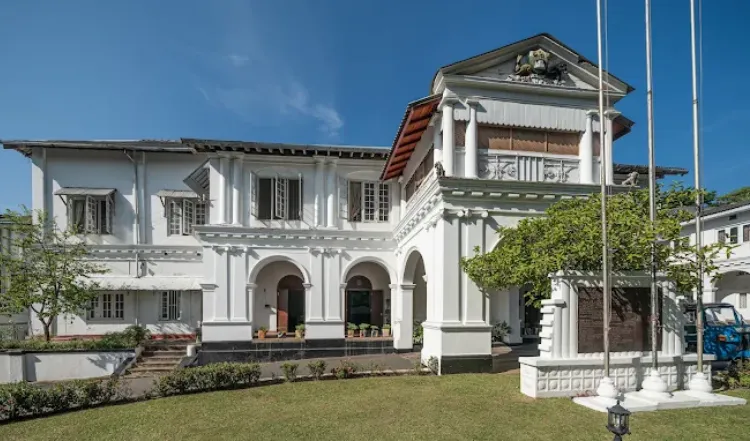
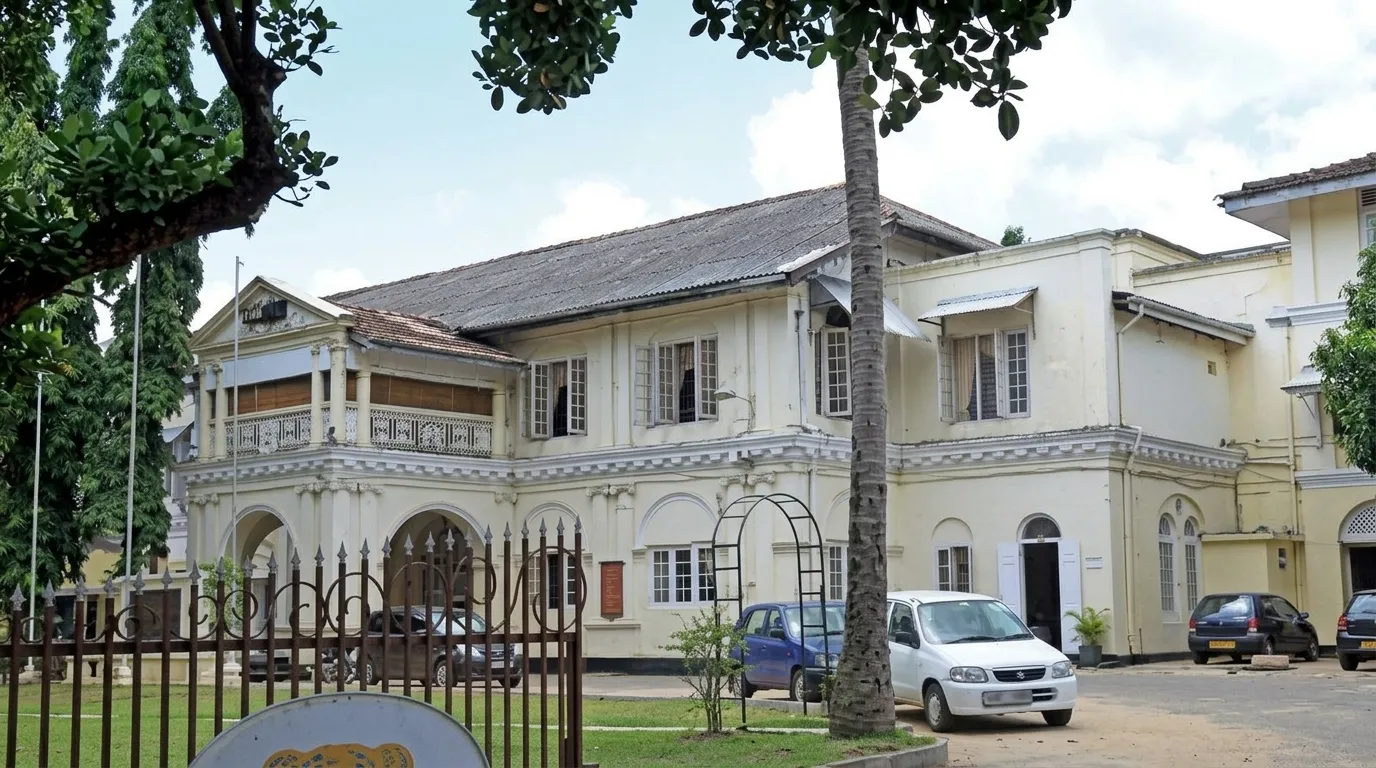
Most people who pass Kandy Town Hall see a busy council office, with cars parked outside and people coming and going on municipal business. Few realise they’re looking at one of the 18 walawwas of the last Kandyan kings, and the only one that has spent more than 150 years as the seat of the city’s government.
This is Dunuwila Walawwa (දුනුවිල වලව්ව), the Kandy home of the Dunuwila family. In the days of the kings, the Dunuwilas held one of the most unusual jobs at court: they were in charge of the royal elephants, and their walawwa stood near the royal elephant stables so they could keep watch over the animals.
In this article, I go through the history of the Dunuwila family, their role as keepers of the king’s elephants, how their walawwa became Kandy’s Town Hall, and the other Dunuwila walawwas around the city.
Dunuwila Walawwa at a Glance
| Sinhala name | දුනුවිල වලව්ව |
| Also known as | Dunuwille Walawwe, Kandy Town Hall |
| Location | Sri Dalada Thapovana Mawatha, Kandy, about 900 m from the Temple of the Tooth |
| Family | Dunuwila, holders of the title Gajanayake Nilame, keepers of the royal elephants |
| Today | Kandy Town Hall: headquarters of the Kandy Municipal Council and office of the Mayor |
| Became Town Hall | 1870 |
| Architecture | A mix of Kandyan, Dutch and British styles |
| Protected status | Archaeological protected monument (8 July 2005) |
| Open to the public | A working council office; view from outside |
The Dunuwila Family
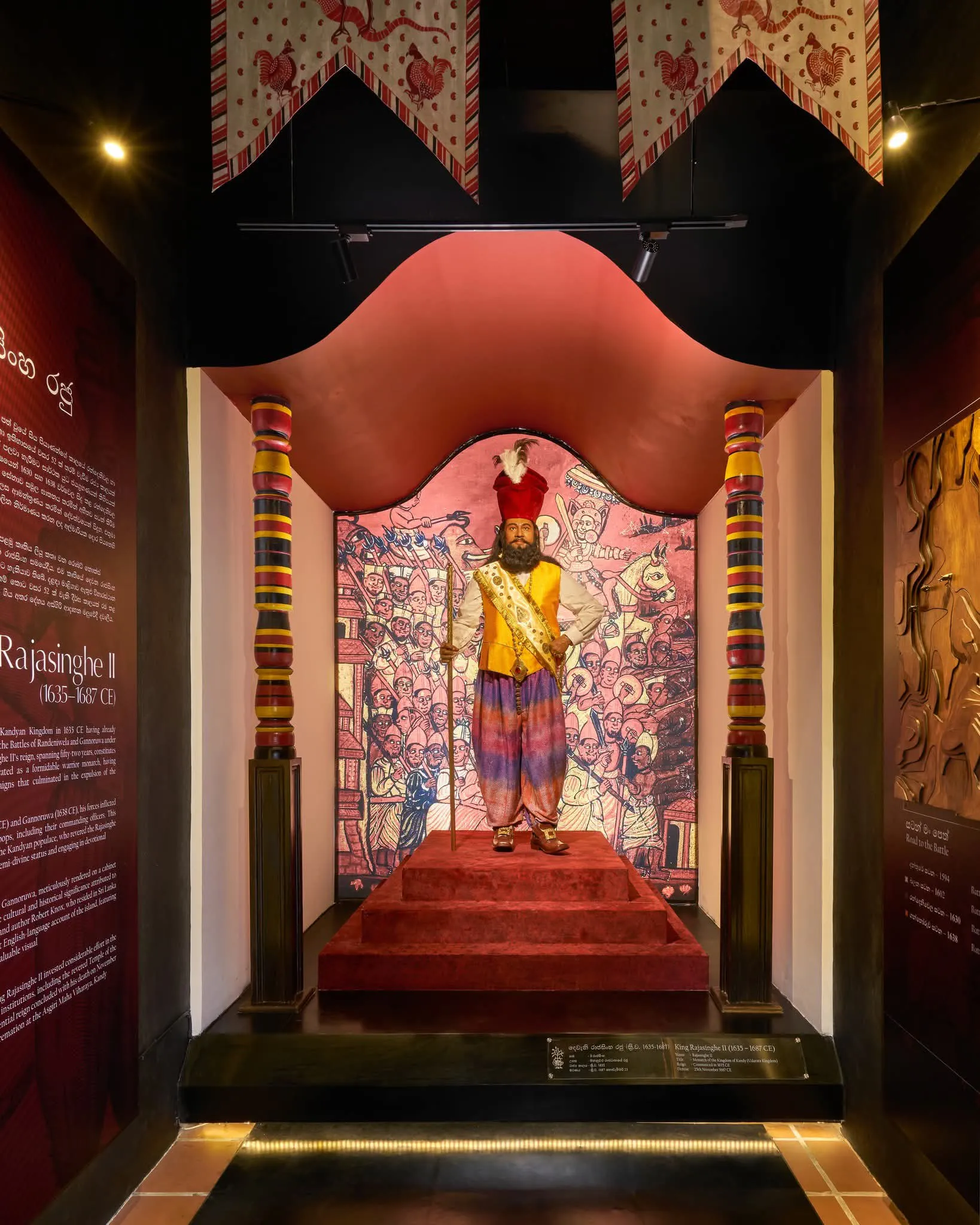
The Dunuwilas (also spelled Dunuwille) were one of the noble radala families of the Kandyan Kingdom. Their known history goes back to the reign of King Rajasinghe II (1635–1687), and they served the kings of Kandy for the next century and a half.
In the time of the last king, Sri Wickrama Rajasinghe (1798–1815), Dunuwila Nilame was one of the courtiers of the royal court, and the family’s city walawwa stood among the 18 noble homes of the capital. J.C. Van Sanden’s The Chieftains of Ceylon (1936) describes the Dunuwilas as an old and distinguished Kandyan chieftain family and records a Dunuwila Disawa who served under King Kirti Sri Rajasinghe (1747–1782) and King Rajadhi Rajasinghe (1782–1798).
Like other noble families, the Dunuwilas strengthened their position through marriage. Kandyan genealogies record a Dunuwille Kumarihamy, the sister of Dunuwille Gajanayake Nilame, who married Unamboowe (also known as Iriyagama Loku Bandara), the Basnayake Nilame of the Gadaladeniya Devale.
Another branch was headed by Udanwita Dunuwila Disawa, himself a Basnayake Nilame, whose daughter Dunuwila Tikiri Kumarihamy married into the Madugalle family. As is common in Kandyan records, the Gajanayake Nilame himself is remembered by his title rather than his personal name.
The poet of the royal court
The Dunuwila chief at the court of the last king was more than a keeper of elephants. A biography of his son, James Alexander Dunuwille, written in the 19th century, describes his father as a poet of some note and a special favourite of the last king of Kandy, Sri Wickrama Rajasinghe, to whom he dedicated one of his Sinhala poems.
Sri Lanka’s National Library catalogue lists a poem called Dunuvila Hatana under the name of Gajanayaka Nilame, published in print in 1910.
A hatana is a traditional Sinhala war poem. Van Sanden’s Chieftains of Ceylon (p. 81) also describes Dunuwila Gajanayake Nilame as a poet and, citing the scholar James De Alwis, credits him with two works: Ratiratna Alankara and Dunuwila Hatana.
The family also fought for the kingdom. According to the same family history, a Dunuwille who became Disawe of Matale received a royal land grant (sannas) in 1807 in recognition of his bravery in risking his life to defend Kandy against the British.
Van Sanden (p. 81) likewise records a Dunuwila Maha Mohottala who defended the Kandyan Kingdom against the British.
Three fathers
The Dunuwila family history also preserves a reminder of an old Kandyan custom: polyandry, in which brothers could share one wife.
James Alexander Dunuwille is described as having had three fathers, all brothers from the Millawa branch of the family: Millawa Wellassa Dissava, Millawa Gabada Nilame, and Millawa Gajanayaka Nilame, later Disawe of Wellassa.
By 1824, the second of them, by then known as Dunnuwille Gabada Nilame, was chief of the royal village of Gampaha and served as an assessor in court. The Millawa and Dunuwila names appear interchangeably in the family’s records, which is one reason its genealogy is so hard to untangle.
After 1815
Like most of the great Kandyan families, the Dunuwilas had to find a place in the new world after the British took the kingdom in 1815. Not all of them accepted British rule quietly. In 1834, just a year after the Colebrooke–Cameron reforms began, the first Adigar Molligoda and Dunuwille Disawe were accused of organising a plot to put a Burmese prince on the throne of Kandy.
Over the 19th century, many members of the family moved into the professions that British rule opened up. In the 1850s, a court record from Kandy lists Dunuwille Lokoo Banda as superintendent of police, along with his brother, James Dunuwille.
James Alexander Dunuwille, born in March 1821 as the youngest of a large family, was sent to Colombo in 1836, aged 15, to study at the Colombo Academy. The Governor of Ceylon, James Stewart-Mackenzie, became his patron and stood as his godfather when he was baptised, giving him the name James Alexander.
He became a lawyer in Kandy and served as Acting Deputy Queen’s Advocate and Acting District Judge of Kandy. He married twice. His death, in 1860 or 1866 (sources differ), would later decide the fate of the family’s city walawwa.
The family also kept marrying into other leading Kandyan houses, especially the Nugawelas. Udanwita Dunuwila Madduma Kumarihamy (1849–1932) married Madduma Banda Nugawela (1841–1901), Raté Mahatmaya of Udunuwara and later Tumpane. A later C.P. Dunuwila served as Raté Mahatmaya of Udunuwara and Yatinuwara and married Margaret Nugawela.
The Dunuwilas in modern Ceylon
In the 20th century, members of the Dunuwila family turned up at the very centre of Ceylon’s public life.
- The wife of Ceylon’s first prime minister. Mollie Dunuwila was the daughter of R.R. Dunuwila, a police magistrate who later became Secretary of the Colombo Municipal Council, and Grace Jayatilaka. In 1910 she married D.S. Senanayake, who became the first prime minister of independent Ceylon in 1947. Their son, Dudley Senanayake, became the country’s second prime minister in 1952. So a Dunuwila was both the wife of one prime minister and the mother of another.
- Two sisters married to a Diyawadana Nilame. Punchi Banda Nugawela, Diyawadana Nilame of the Temple of the Tooth from 1916 to 1937 and a member of the first State Council, married Mallika Dunuwila, the elder daughter of a Dunuwila Disawa who was also a police magistrate. After her death, he married her younger sister, Anula Dunuwila. He’s the same Nugawela who rebuilt the family walawwa that is now The Manor House hotel.
- A Deputy President of the Senate. B.H. Dunuwille (born 1896), a proctor educated at Trinity College, Kandy, was a member of the Senate of Ceylon and its Deputy President from 1947 to 1970.
- The girl behind a famous baila. Damayanthi Dunuwila, a musician and the daughter of Richard Dunuwila and Gladys Aluwihare, once sailed a yacht from Colombo to Lisbon. The well-known baila “Kandy Lamissi” is said to have been composed about her escapades as a young woman in Kandy.
- A link to the world’s first woman prime minister. According to Cinnamon Hotels, Sirimavo Bandaranaike was also descended from Lady Dunuwila (see The Other Dunuwila Walawwas, below).
The family genealogies don’t show exactly how these later branches connect to the Gajanayake Nilame of the 1800s, so it’s safest to think of them as members of the wider Dunuwila family rather than his direct descendants.
A Dunuwille in the Mayor’s chair
The family’s link with the old walawwa came full circle in the 20th century. Harindra Dunuwille, B.H. Dunuwille’s son and a lawyer educated at Trinity College, Kandy, served as a Member of Parliament for Kandy District from 1989 to 1994, including as Deputy Minister of State for Constitutional Affairs from 1989 to 1993, and then as Mayor of Kandy for two terms, from 1997 to 2002. As Mayor, his office was in the Town Hall, the walawwa that had once belonged to his family.
Keepers of the Royal Elephants
Elephants were at the heart of the Kandyan court. The king had his own royal elephant, whose only task was to carry him, while others were trained for war and for heavy work. Looking after them was a position of real honour, and it was entrusted to a noble family who held the title of Gajanayake (from gaja, elephant, and nayake, leader).
In the late Kandyan period, that family was the Dunuwilas. Dunuwila Adhikaram was the Nilame in charge of the royal elephant stables, which is why he was also known as Dunuwila Gajanayake Nilame. His walawwa in the city was built close to the stables so that he could keep watch over the king’s elephants.
One note of caution: the title Gajanayake itself points to the royal elephants, but the specific story that the Dunuwila walawwa was built beside the stables comes from modern accounts. I haven’t found it in an older historical source.
What happened to the stables
After the British took Kandy, the royal elephant stables were destroyed. Their land, which belonged to the Asgiri Maha Viharaya, was taken over by the British government and given to the Muslim community to build a mosque. Today the site is the Meera Makkam Jumma Mosque, next to the Asgiri Gedige Viharaya, a reminder of where the king’s elephants once lived.
Elephants still play a central role in Kandy’s life every year, carrying the sacred casket and leading the processions of the Esala Perahera, but the noble office of keeper of the royal elephants ended with the kingdom.
The Walawwa
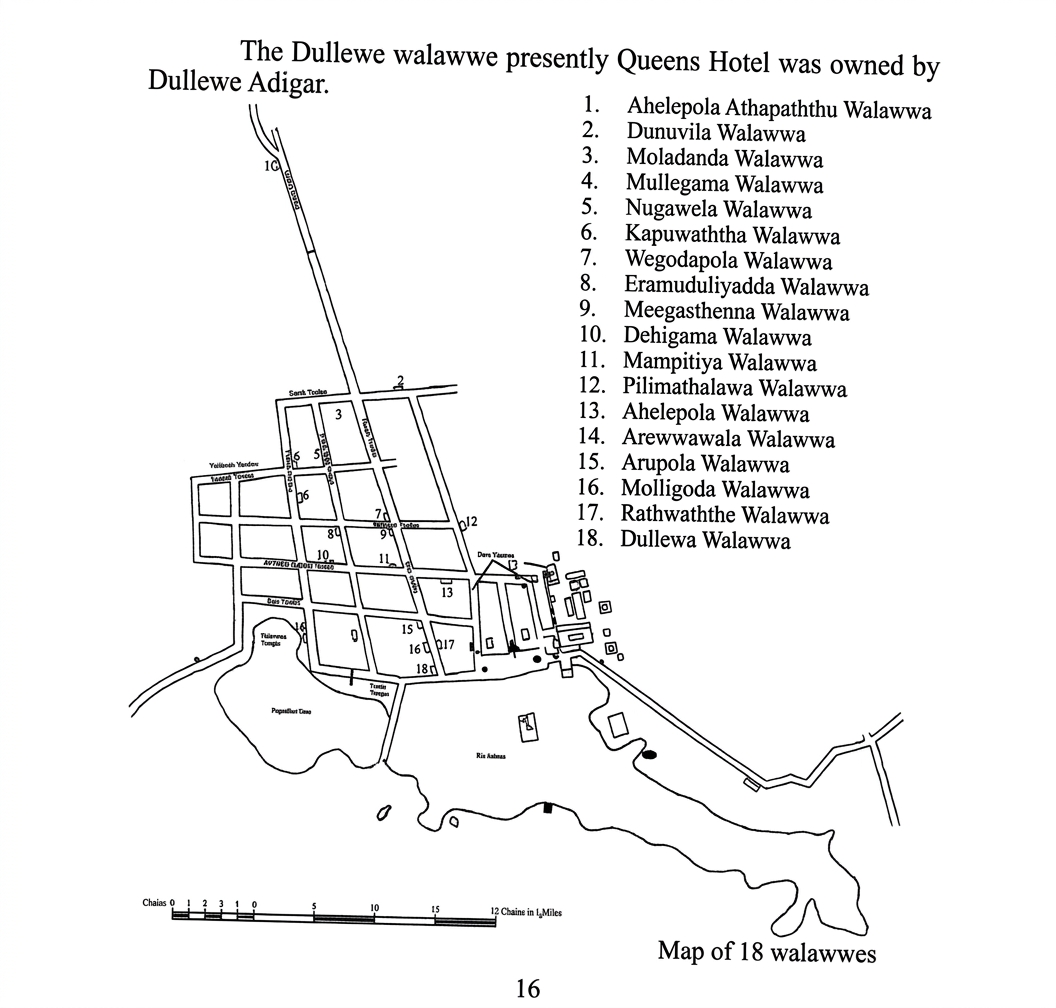
Dunuwila Walawwa was one of the 18 walawwas that stood in the grid of streets beside the palace and the Temple of the Tooth in the last years of the Kandyan Kingdom. It’s listed as No. 2 on the historical map of the 18 walawwas published by the Kandy Municipal Council’s World Heritage Advisory Committee, the same map later reproduced by JICA in its Greater Kandy Urban Plan.
Unlike most of the 18, it survived. The building that stands today has been altered many times over two centuries of government use, and it now shows a mix of Kandyan, Dutch and British architectural styles. Burmese teak was used for its timber, though probably not in its original form. Even so, it’s one of only a handful of the 18 city walawwas still standing, and the only one that’s been in continuous public use for more than 150 years.
The walawwa was gazetted as an archaeological protected monument on 8 July 2005, along with many other historic buildings in the centre of Kandy.
From Walawwa to Town Hall
The story of how a noble family’s home became the seat of Kandy’s council is told in two different ways, and the sources don’t fully agree.
The government years
According to local heritage accounts, the British took over the walawwa in 1815, as they did many of the chiefs’ houses in the city. In 1848 it was taken over by the police, and on 31 October 1861 the government paid £3,000 for the building and used it for government offices, before it eventually became the home of the Municipal Council.
The 1870 auction
The more detailed record, from a history of the Kandy Municipality published in The Island in 2007, tells a different story. James Alexander Dunuwille, the Acting Deputy Queen’s Advocate, died in 1860 or 1866 (sources differ). To settle the death duty (estate tax) on his estate, the Dunuwille Walawwe was sold at a court-sanctioned auction, and in 1870 the newly formed Kandy Municipal Council bought it for about £480. It became the city’s Town Hall.
Both accounts may be partly true. The walawwa could have been used by the government for some years while still belonging to the family, before being sold after J.A. Dunuwille’s death. But until the records are checked, the 1870 auction is the best-documented version.
A new council for Kandy
The timing fits. The Kandy Municipal Council was established on 20 March 1866 under the Municipalities Ordinance of 1865. Kandy was only the second city in Ceylon to become a municipality, four months after Colombo, with Galle following that December. At the 1871 census, five years later, the municipality had 16,881 people.
The new council needed a home, and the walawwa of the old keepers of the royal elephants became it. The post of Mayor of Kandy was created in 1866, and the Mayor’s office has been in the Town Hall ever since.
The Town Hall today
Today the old walawwa is still the headquarters of the Kandy Municipal Council and the office of the Mayor of Kandy, and it houses the council’s administrative staff. It’s a working government office, so most visitors only see it from outside.
The Other Dunuwila Walawwas
Like many Kandyan families, the Dunuwilas had more than one walawwa. Two more are linked to the family on the outskirts of Kandy, both near the Mahaweli River.
St. Anthony’s College, Katugastota
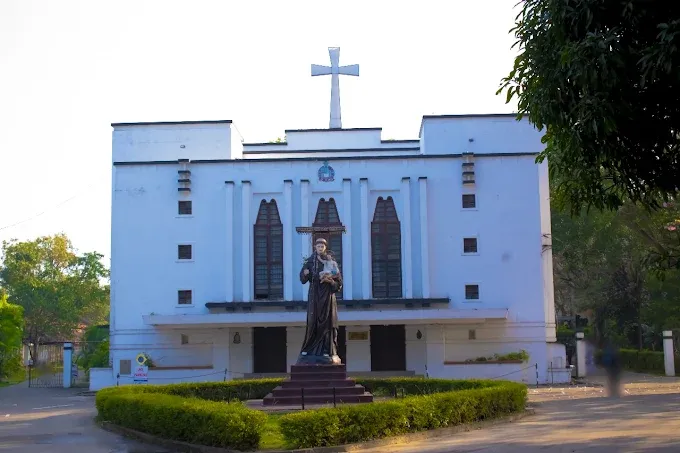
By the 1920s, St. Anthony’s College had outgrown its cramped premises next to the cathedral in Kandy. In 1927, Bishop Bede Beekmeyer, himself an old boy of the school, bought the old Dunuwille Walauwa at Katugastota, which became the college’s present home.
Turning a walawwa into a school took a lot of work. Drains were dug around the building, the outer walls were strengthened, the inner walls were removed and replaced with pillars, and the roof was supported with new trusses. Classes were first held in a shed of coconut pillars, mango-wood rafters and wattle-and-daub walls, and the verandah of the old walawwa was used as the school chapel. The junior boarders moved in on 16 January 1928, and trees were planted to mark the occasion.
Cinnamon Citadel, on the Mahaweli
According to Cinnamon Hotels, the land where Cinnamon Citadel Kandy now stands was once another Dunuwila Walawwa. This one was built during British rule by William Dunuwille, the Raté Mahatmaya (chief headman) of the area. A brass statue believed to represent the lady of the house is still kept at the hotel. The family is also linked to Sirimavo Bandaranaike, the world’s first woman prime minister, who was a descendant of Lady Dunuwila.
The hotel stands on the Mahaweli riverbank a few kilometres from Katugastota, so it isn’t clear whether this and the walawwa bought for St. Anthony’s are two different houses or two accounts of related family properties.
Visiting Dunuwila Walawwa
Location: Kandy Town Hall, Sri Dalada Thapovana Mawatha, Kandy, about 900 m (a 10-minute walk) from the Temple of the Tooth
What you can see: the exterior of the Town Hall from the street.
Tips
- It’s a working office. The Town Hall is the Municipal Council’s headquarters, so treat it like any government building. If you have business there, you’ll get a glimpse of the inside.
- Look for the old house. The building mixes Kandyan, Dutch and British styles, so see if you can tell the older parts of the house from later additions.
- Be careful with photos. Taking pictures of the exterior from the street is usually fine, but ask before photographing staff, offices or anything inside.
Nearby
- Meera Makkam Jumma Mosque and Asgiri Gedige Viharaya: on the site of the old royal elephant stables that the Dunuwilas once looked after.
- Ehelepola Walawwa: on Raja Veediya, now Sri Lanka’s first wax museum. Read our Ehelepola Walawwa guide.
- Royal Bar & Hotel: the old Mampitiya Walawwa, also on Raja Veediya.
- Giragama Walawwa: at the corner of Yatinuwara Veediya and Colombo Street, the oldest walawwa building in the city.
- Temple of the Tooth: a 10-minute walk away.
Final Thoughts
Dunuwila Walawwa has had one of the quietest second lives of all Kandy’s walawwas. There was no prison and no dramatic restoration, just a noble home that became the place where the city has been governed for more than 150 years.
The next time you pass the Town Hall, remember that it was once the home of the men who looked after the king’s elephants.
Location Map
Nearby Atractions
- Udawatta Kele Sanctuary – A Tranquil Forest Reserve in Kandy - 0.4 km
- Ehelepola Walawwa, Kandy: The Story of a Noble Family, a Prison and Sri Lanka's First Wax Museum - 0.5 km
- Ehelepola Walawwa - (Wax Museum kandy) - 0.5 km
- Athgala Sri Dalada Maligawa - 0.6 km
- Sri Dalada Maligawa - Temple of Tooth Relic - 0.7 km
- Bahirawakanda Temple Kandy - 0.9 km
- Pekoe Trail Stage 2 – Galaha to Loolkandura Scenic Hiking Guide - 2.6 km
- Adigar's Manor: Sleeping Inside the Last Days of the Kandyan Kingdom - 3.6 km
- Nelligala International Buddhist Centre, Kandy: A Complete Visitor's Guide - 8.7 km
- Sagama Raja Maha Viharaya - 9.6 km